
Building sustainably
We are committed to achieving net zero carbon across our value chain by 2045 in line with our science-based targets and the UK’s climate goals. Our net zero transition plan sets out clear ambitions, actions, and accountabilities to decarbonise our operations and value chain, build climate resilience, and support a just transition to a low-carbon economy.
Our ambition aligns with the Paris Agreement’s 1.5°C pathway, targeting emissions reductions across operations, supply chains, and the homes we build. To stay on track, we have set clear interim milestones reinforcing continuous progress and sector leadership.
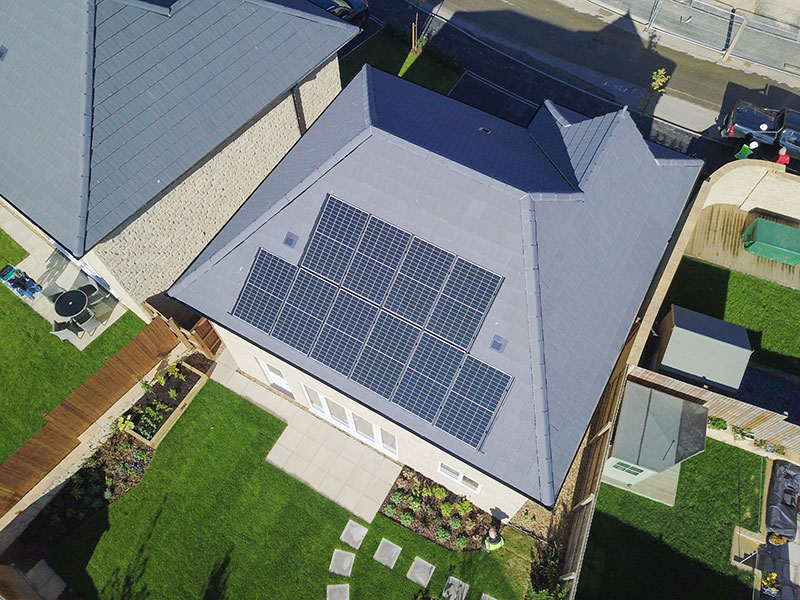
We are already making strong progress through innovations in the supply chain, enhanced home performance, and lower-carbon operations. These actions deliver benefits for customers and our value chain, while helping drive industry-wide transformation.
Our transition plan considers both transition and physical climate risks, as well as the opportunities and decarbonisation pathways associated with achieving net zero. While some transition risks are currently a short- to medium-term priority, we continue to address physical risks and recognise that climate adaptation will remain an important focus for our business going forward. Risks and opportunities are managed through our broader climate risk management approach and are reported in detail in the sustainability-related risks and opportunities in the Annual Report.
Achieving net zero is closely connected to protecting and restoring nature. Climate and nature are deeply interconnected, not only in terms of risk, but also in the solutions we choose to deliver our net zero ambitions. In parallel, nature plays a vital role in strengthening climate resilience across our developments, supporting long-term adaptation to risks such as overheating and flooding. See our nature page here
Delivering our net zero ambition relies on evolving skills across our business, supply chain, and industry. Skills development enables workers to adapt to changing industries, access new green jobs, and maintain livelihoods as economies decarbonise.
Using best practice guidance from the UK Transition Plan Taskforce (TPT), we developed our plan to be a transparent and structured roadmap, ensuring our progress is accountable and meets the expectations of customers, partners, and stakeholders.
Our targets
Delivering a resilient and future-proofed net zero strategy requires both immediate action and long-term commitment.
In 2026, the Group updated its near-term and long-term greenhouse gas emissions reduction targets following the combination of Barratt and Redrow. These targets replace the Group’s previous emission reduction targets, and have been developed and validated in line with the Science Based Targets initiative (SBTi) Buildings Sector Guidance based on an absolute contraction approach under an IPCC-aligned 1.5°C pathway.
There are three strategic targets:
- Operations (scopes 1 and 2): Reduce operational emissions from our sites, plots, offices and fleet by 46.4% by FY35 and net zero by FY4512.
- Upfront embodied carbon (scope 3): Reduce the upfront embodied carbon associated with the homes we build by 45% by FY35 and net zero by FY452.
- Homes-in-use and wider value chain (scope 3): Reduce in-use emissions associated with the homes we build and across the wider value chain by 45% by FY35 and net zero by FY452.
Footnotes:
1) The target boundary includes land-related emissions and removals from biogenic feedstocks.
2) Against a 2025 base year.
For ease of presentation, we aggregate emissions to these three strategic targets. SBTi targets break out emissions in more detail and we explain this in the dropdown below.
Origins of our emissions
Understanding where our emissions come from is essential for targeted decarbonisation initiatives. 1% of the Group’s emissions are produced as a result of our direct operational activities. The remaining 99%comes from the transformation of raw materials into products, transport to sites, site preparation and groundworks, the emissions arising from energy use of the homes we build over their lifetime and wider value chain emissions arising from administrative activities.
Explore more
Sustainability governance
Data and performance